Go ahead, hate on Chequamegon.
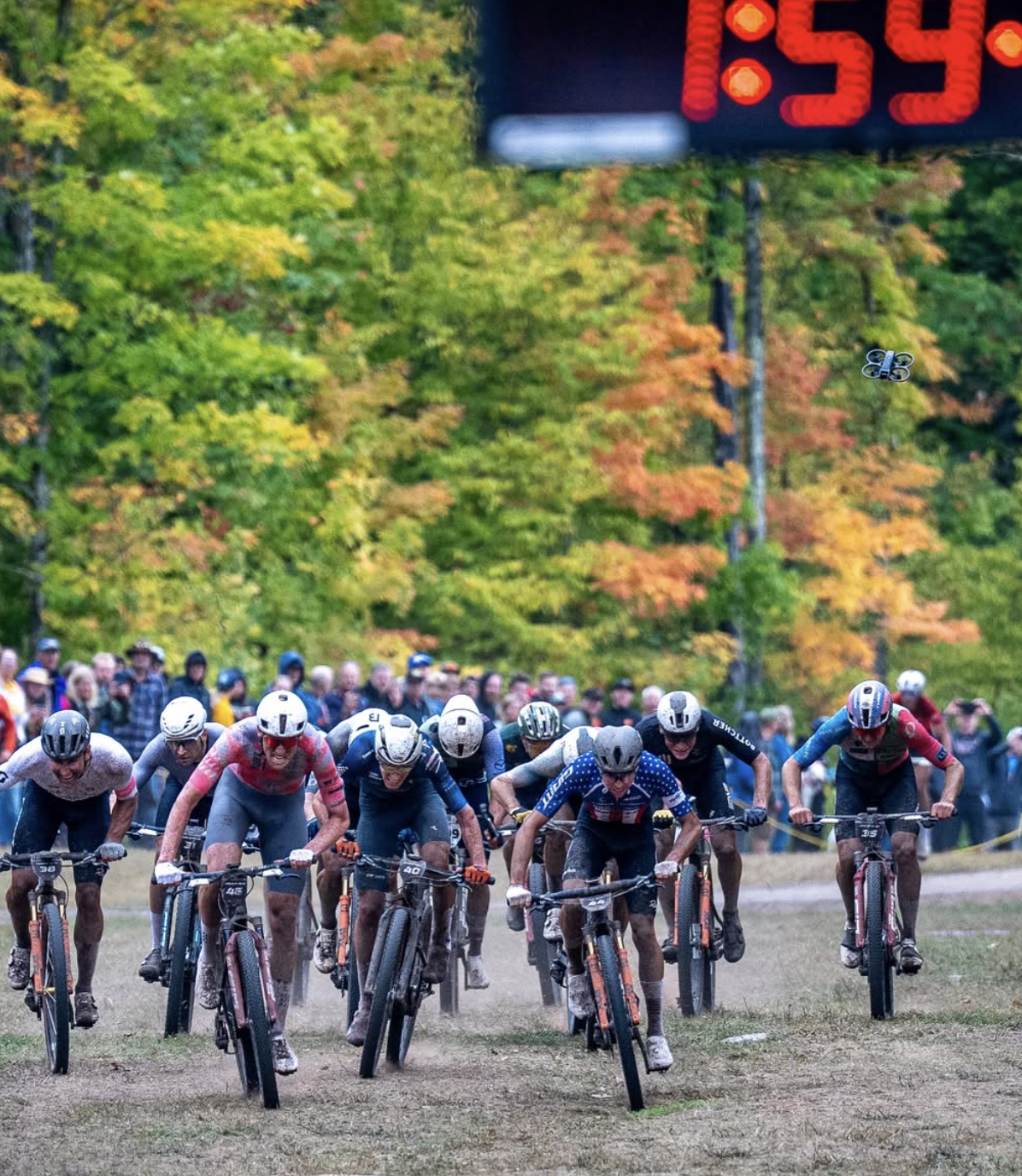
Go ahead, hate on Chequamegon. The racing keeps delivering. It’s only 40 miles, it’s not technical, and compared to the increasingly epic direction of modern off-road racing, it can feel almost easy. But that might be exactly why it keeps us on our toes. There’s no six-hour war of attrition and far less waiting around for the strongest riders to slowly cook everyone else. Instead, Chequamegon gives us two hours of aggressive racing, big groups, tactical decisions and enough uncertainty to make it one of the most entertaining stops on the Grand Prix calendar. This year was no exception, let’s get into it.
Women’s Race: A big group, crash, rising pressure and one decisive move.
The women stayed remarkably intact early, with roughly 18 riders forming the front group and Sarah Lange repeatedly showing herself near the front. Sofia Gómez Villafañe briefly found herself chasing after an early crash, where she got tangled with Meliss Rollins. SGV got back on, and quickly went from chasing the race to controlling it.
Villafañe started applying pressure through Martell’s Pothole, leading the singletrack and stretching the group on the approach to Fire Tower. She hit the climb with a small advantage and crested roughly 15 seconds clear. From there, the gap pushed toward a minute while Karolina “Karo” Migoń, Cecile Lejeune and Lange led the pursuit behind.
Migoń and Lange eventually emerged as the primary chase and had Villafañe’s advantage back around 30 seconds with nine miles remaining. That was enough to make the outcome legitimately uncertain, but Villafañe had enough left to hold them off, finishing 16 seconds clear for her third Grand Prix win in four rounds.
Migoń took second with Lange on the same time in third. Migoń’s ride deserves some extra attention. She has been relatively quiet in the Grand Prix this season, then showed up at Chequamegon on flat bars and nearly rode herself back into a race Villafañe had seemingly blown apart. Lange continues to look less like a rider trying to hang with the favorites and increasingly like one of the riders capable of shaping the race herself.
Men: Fast, tactical and increasingly shaped by the points battle.
The men’s race brought an entirely different layer of chaos, along with real signs that the 2026 Grand Prix points battle is starting to influence how these guys race.
Martins Blums spent much of the day dangling off the front, at one point carrying an advantage over a minute. Blums started the race sitting in 13th in the LTGP standings, which matters. Letting him float up the road carries a very different consequence than giving that same advantage to Brendan Johnston, Alexey Vermeulen, Cole Paton or another rider fighting for series position.
Four races into the season, the calculus is getting more complicated. Riders aren’t only marking the obvious podium threats anymore. The recently announced 2027 qualification rules automatically invite the top 10 from this year’s Grand Prix back into the series, putting additional value on positions deeper in the standings. A rider sitting seventh, eighth or ninth suddenly has considerably more reason to care about the wheel of the guy sitting 11th.
Matt Wilson appeared considerably less interested in the math.
Wilson put in a massive acceleration on Fire Tower, with Keegan Swenson responding as the rest of the favorites stretched behind. For a moment, it looked like the climb had broken the men’s race open just as it had for the women.
It hadn’t. The move came back together after Fire Tower. Swenson and Alexey Vermeulen later pointed to the combination of extremely high speeds and a headwind that made maintaining separation difficult. Once the favorites regrouped, the race shifted into a tactical fight, with attacks going and riders increasingly reluctant to spend energy closing moves that might ultimately benefit someone else.
Wilson kept attacking anyway.
After his Fire Tower move was neutralized, he eventually got clear again with Swenson, Andrew L’Esperance and Johnston as they reeled Blums back in. Around the catch, Wilson attacked once more and finally created the separation that mattered. He held it to the finish for his first Grand Prix victory, with Johnston second and Swenson third.
Third was a useful result for Swenson. He is skipping Little Sugar in favor of the UCI Gravel World Championships in Australia, making Chequamegon an important opportunity to collect points before using his drop race. He indicated afterward on social media that he was plenty satisfied with the result. With his position atop the standings, he has put himself in a strong position heading toward Big Sugar.
Chequamegon Keeps Making a Pretty Good Case for Itself
The broader lesson from Chequamegon has less to do with who won and more to do with why the racing was so good.
Shorter, less attritional races create different bike racing. Last year’s 50-mile Little Sugar was a great example. The modified, and ultimately easier, Leadville course produced another this year. Chequamegon might be the clearest case yet.
When a course doesn’t simply grind the field down until only the strongest riders remain, more people survive long enough to matter. Groups stay larger. Positioning matters more. Attacks don’t automatically create permanent separation. Riders have to decide who deserves a chase, who can be allowed up the road, when to bluff and when to spend the match. Add a tightening Grand Prix points battle to that equation and the psychology gets even more interesting.
Fitness still decides bike races. It just doesn’t have to make every decision.
That’s where Chequamegon continues to punch above its weight. It may not have the distance of UNBOUND, the altitude of Leadville or the technical reputation of some of the newer Grand Prix stops, but it consistently creates racing that remains uncertain deep into the day.
The racing is only part of why Chequamegon works. Nearly 2,000 riders descend on northern Wisconsin for a weekend that feels more like a bike festival than a race, complete with Little Loggers kids races and a finish line that stays packed deep into the afternoon. The late pro start is a big part of the magic: thousands of riders have already finished their own race and stick around to watch the best in the world come charging into Cable. It creates an atmosphere that is hard to manufacture and even harder to replicate. Chequamegon may not get the attention of the biggest events in the Life Time portfolio, but it has become one of its unsung heroes.